Building and caring for a terrarium is mostly about working gently in a small, enclosed space, and the right tools make that far easier. You do not need a drawer full of gadgets, but a handful of well-chosen pieces will save you frustration and protect your plants.
Why the right tools make a difference
A terrarium is a narrow world. Once the glass walls go up, your hands become clumsy visitors in a landscape that is only a few centimetres across. Reaching past delicate mosses to tuck a fern root into place is difficult with fingers alone, and it is easy to crush a plant or smear soil across the glass in the process.
Good tools give you reach, precision, and control. They let you place a plant exactly where you want it, firm the substrate around its roots, and tidy up afterwards without disturbing everything else. That care shows in the finished planting, and it shows again months later when your terrarium is settled and thriving.
A terrarium rewards patience. The slower and more deliberate you work, the better the result looks and the less you disturb the roots you cannot see.
The core kit: tools you will use every time
These are the pieces that earn their place in almost every build and every bit of maintenance afterwards. If you are starting from scratch, this is the short list worth having before you plant.
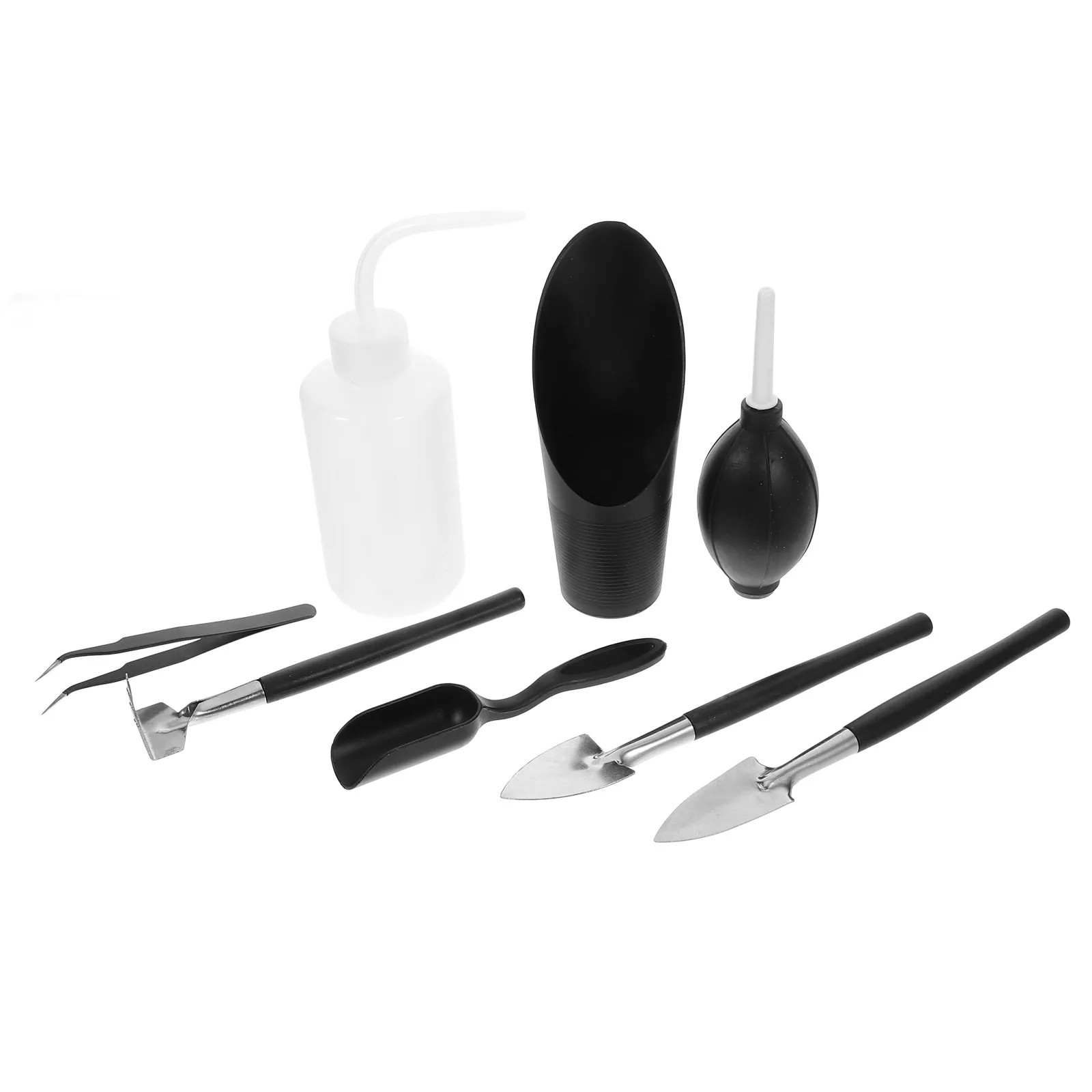
- Long tweezers. The single most useful tool. Angled or straight, they let you position small plants, place cushions of moss, and lift out a fallen leaf from deep inside a tall vessel without putting your whole hand in.
- A small spade or trowel. For digging planting holes in the substrate and moving soil around without disturbing the layers beneath. A narrow blade works better than a wide one in tight corners.
- A scoop or funnel. For pouring drainage gravel and substrate cleanly to the bottom of the vessel, especially in bottles and jars with a narrow neck. It keeps soil off the glass walls, where it is hard to clean later.
- A tamper. A flat-ended tool for firming substrate and pressing moss into contact with the soil. Good root and moss contact is what helps a planting establish rather than dry out.
- A soft brush. For sweeping stray soil off leaves and glass as you work, so the inside stays clean and clear.
- Fine snips or scissors. For trimming roots before planting and pruning back growth once the terrarium matures.
Buying these as a set is usually the simplest way to begin, since the pieces are sized to work together and to reach into an enclosed vessel. Our Maker’s Kit terrarium tool set gathers the essentials in one place, which saves hunting down each item separately.
Watering and misting tools
How you add water matters as much as how much you add. A heavy pour can wash away a fresh planting or flood the drainage layer, so precision here protects all the work you have just done.
A fine mister
For closed terrariums, mosses, and tropical plants that like humidity, a fine mist is the gentlest way to add moisture. It settles evenly over leaves and the surface of the substrate without pooling or displacing soil. A mister is also how you refresh a closed terrarium that has dried slightly, rather than soaking it.
A well-made sprayer that produces a genuinely fine mist, like The Mister glass plant sprayer, is worth choosing over a coarse spray bottle. The finer the droplets, the more even the coverage and the less risk of overwatering. For more on getting this balance right, our guide on how to water a terrarium walks through timing and amounts.
A squeeze bottle
A narrow-spouted squeeze bottle is the tool for targeted watering. It lets you direct a small amount of water to a specific plant’s roots, or run a little down the inside of the glass to top up the drainage layer, without wetting everything else. It is especially handy in planted arrangements where some plants want more water than their neighbours.
Nice-to-have extras
None of these are essential, but each one solves a particular problem and makes the work more pleasant once you are past your first build.
- An air blower. A simple rubber bulb blower puffs stray soil and debris off leaves and moss without touching them, which is far gentler than a brush on soft new growth.
- A tamping ram or cork. Useful for firming substrate at the bottom of tall, narrow vessels your fingers cannot reach.
- A pick or dibber. A fine point for teasing apart small root balls, making planting holes, and nudging moss into gaps.
- Bent or angled tweezers. If you work with tall bottles or deep tanks, a second pair with an angled tip reaches around corners that straight tweezers cannot.
Looking after your tools
Terrarium tools live an easy life compared with garden tools, but a little care keeps them working well and keeps your terrarium healthy.
- Wipe soil off blades and tweezers after each use so nothing dries on and rusts.
- Rinse and dry anything that has touched wet substrate before storing it.
- Keep tweezers and snips in a roll or case so the fine tips stay straight and sharp.
- If you move between terrariums, give tools a quick clean in between to avoid carrying mould or pests from one to another.
Clean tools are also part of good terrarium hygiene. A blade that has just cut through a mouldy stem can spread spores if you use it again straight away, so a quick wipe is worth the moment it takes.
Start with the essentials
You can build a beautiful terrarium with just a pair of long tweezers, a small spade, and a fine mister. Everything else is there to make the job easier as your plantings grow more ambitious. If you are putting together your first setup, our step-by-step guide on how to build your first terrarium shows exactly where each of these tools comes into play.
Gather the core kit, work slowly, and let the tools do the reaching. Your plants, and your patience, will thank you for it.